
Whitebark Pines & Clark’s Nutcrackers: A Co-Dependent “Situationship”
Blog written by YW Naturalist Mads B.
Soon after moving to the Greater Yellowstone Ecosystem, I joined a friend on a backpacking trip through the Teton Wilderness. We bushwacked through late-spring greenery up to our chests, climbed a steep hill, and set up camp on a low ridge. After this grueling day, we were both ready for a long sleep. And having little-to-no plans for the next day, I looked forward to sleeping in.
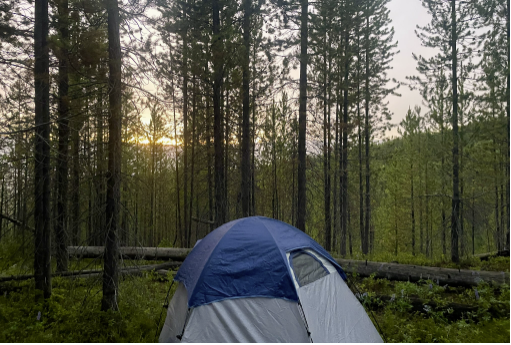
Sunset over the campsite on a backcountry trip in the Teton wilderness.
One bird, however, had other plans.
At dawn, I was awoken by a bird call I can only describe as a screaming robot. Not yet ready to open my tent flaps to the morning light, but with no hope now of falling back asleep, I pulled out my phone and navigated to the Merlin Bird ID app. Five seconds of audio recording later and it identified the bird as a clark’s nutcracker (Nucifraga columbiana), a bird I had only read about. At that, despite the early hour, I smiled… because I was in the presence of one of the saviors of our forests.
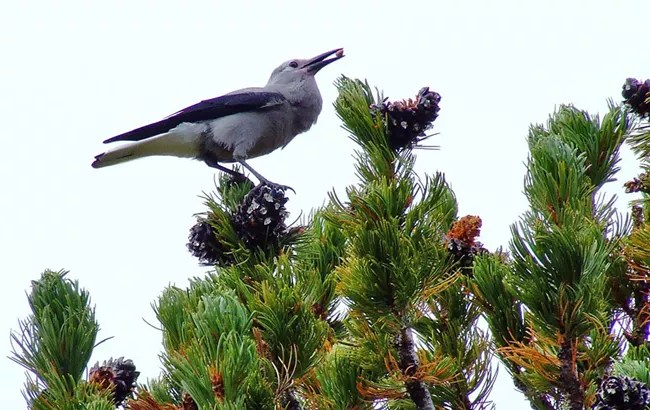
A Clark’ nutcracker sits atop a whitebark pine gathering seeds that will be cached for winter. NPS Photo Teresa Lorenz
The whitebark pine (Pinus albicaulus) is a high elevation tree that plays an important role in biodiversity, water quality, and snowpack retention in the Greater Yellowstone Ecosystem. Its benefits are so significant that it is considered a keystone species, thus, losing this tree could cause widespread harm.
Right now, their populations are being decimated. In 2023 whitebark pines were listed as threatened under the Endangered Species Act, as their populations have begun to significantly decline due to: climate change, the native mountain pine beetle (Dendroctonus ponderosae), and an invasive fungus that causes the white pine blister rust disease. Because their populations are in decline, in addition to adding protection measures to current trees, more need to be planted. This is where the clark’s nutcracker comes in.
Clark’s nutcrackers and whitebark pines have a mutualistic relationship, meaning they both benefit from each others’ presence. Functioning as a trade, the bird harvests the highly nutritious seeds for food, and as a result, the tree’s seeds are dispersed.
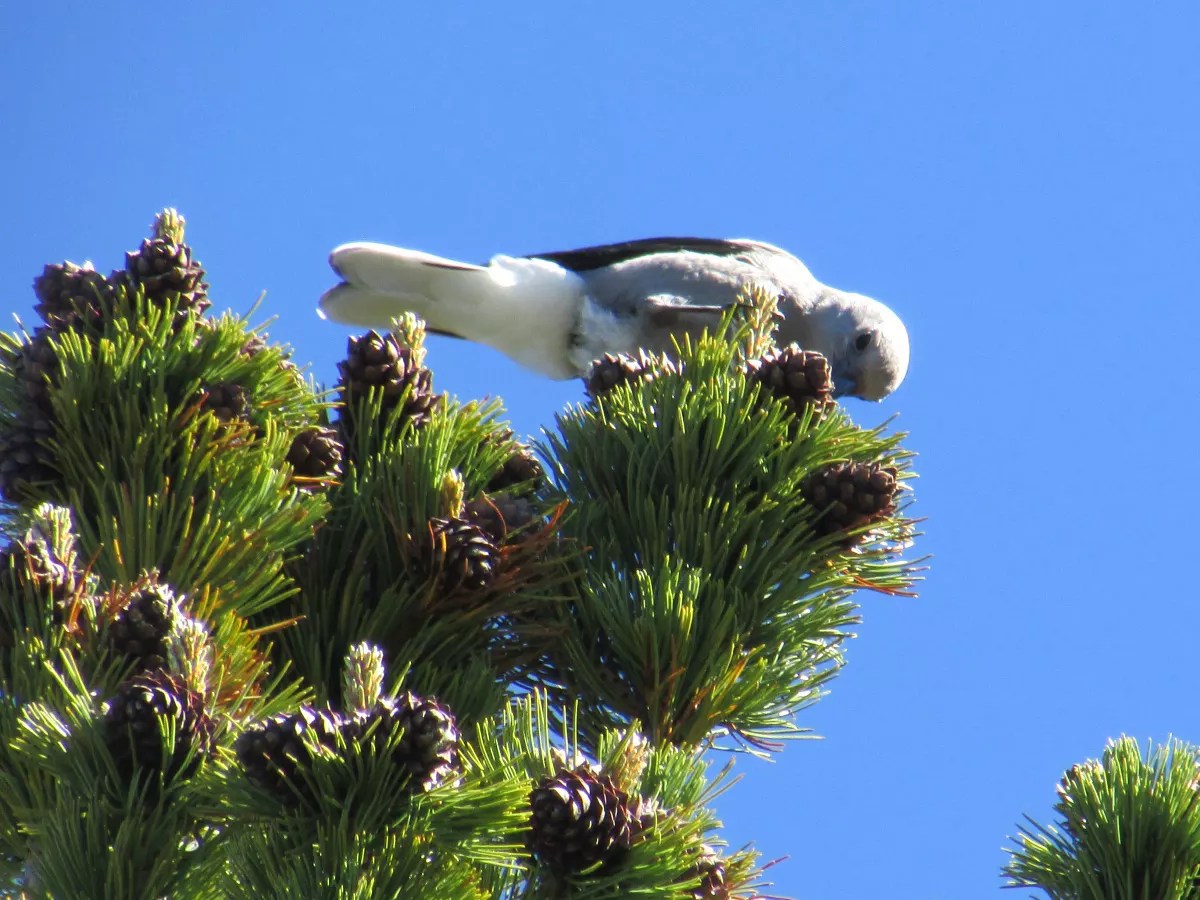
A clark’s nutcracker plucks the seeds out of a whitebark cone that will not open on it’s own. NPS Photo by Jen Hooke
Having co-evolved alongside one another, whitebark pine cones do not open by themselves and instead rely on the nutcrackers to pick the seeds out. The seeds usually mature come late summer, when you can see clark’s nutcrackers and sometimes bears and ravens pining after their seeds (yes, pun intended).
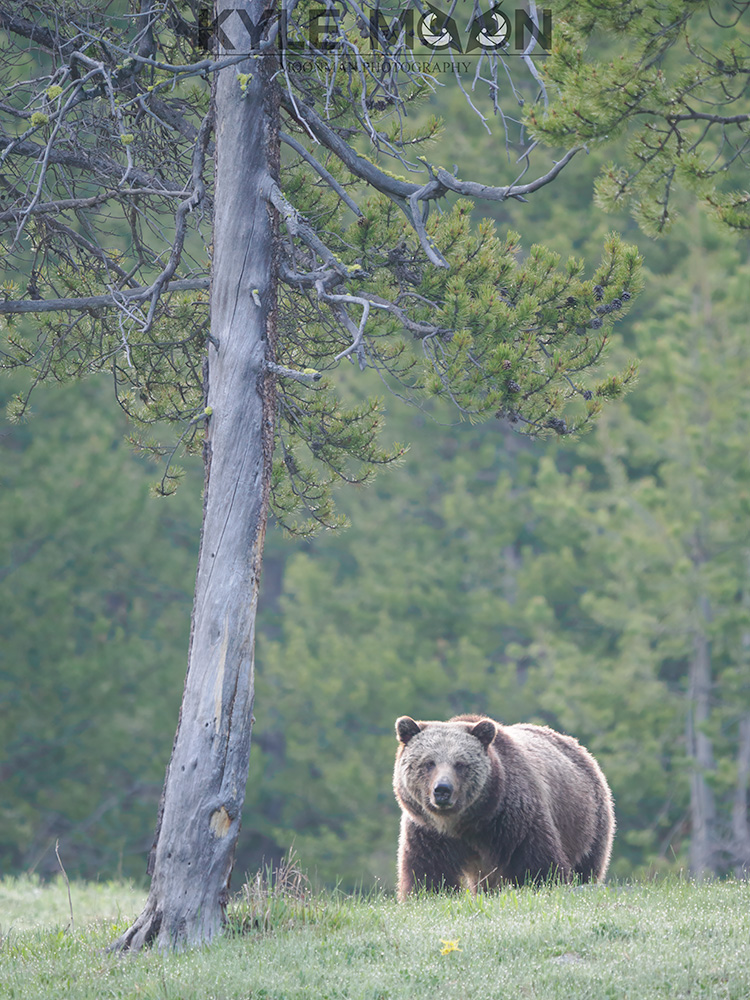
Grizzly bears feast on whitebark pine seeds in fall as they ripen. However, they will sniff out the “forgotten” caches of the birds at any time. Photo by Kyle Moon.
The clark’s nutcracker disperses the seeds most significantly. Its slender beak allows it easy access into the cones, after which, it stores up to 100 seeds in their sublingual pouch, a small sac beneath their tongue. They can fly sometimes several miles with these seeds, caching, or hiding them for later, as a winter food supply. Immensely intelligent, they remember up to 90% of their thousands of cache locations. What’s important for the whitebark pine is the forgotten 10% that have the potential to germinate and grow into more trees.
While clark’s nutcrackers do sustain whitebark pine populations, their impacts alone don’t balance out against the threats the tree faces, so human intervention is required. These efforts include planting disease-resistant trees and using Verbenone pouches, a synthetic pheromone that discourages mountain pine beetles. Despite this, the outlook still isn’t great. They are predicted to lose up to 80% of their habitat by 2050 because of climate change.
So what do we do with this rather bleak information?
Yes, learning the tree’s plights can feel hopeless, lonely, infuriating. In the words of Aldo Leopold: “One of the penalties of an ecological education is that one lives alone in a world of wounds” (A Sand County Almanac).
But I would argue that education is a gift. To know a place is to love a place, and love makes us better stewards. If I hadn’t known about the impact of clark’s nutcrackers on whitebark pines, a key component to some of the most beautiful ecosystems, I might have just grunted in annoyance at a bird that woke me up from the best sleep. But knowing them, loving them, I realize just how special they are. Maybe one day, with action taken and changes made, their presence won’t feel like such a gift.
We are at a critical moment in our history with a multitude of threats changing the world around us. We can wait for the worst to come, or we can try our very best to save the things we love. So share the stories of the whitebark pine and clark’s nutcracker, volunteer, donate, and “let the soft animal of your body love what it loves” (Mary Oliver, Wild Geese)
To learn more about Mads, and the rest of the Yellowstone Wild team, visit our About Us page!