
Quick Details
Start time: varies by date & pickup location – see dropdown menu below
Meeting Locations: Gardiner, MT, Mammoth Hot Springs
Alternative Meeting Locations: Sage Lodge, Chico Hot Springs, or Emigrant General Store (+$150)
Duration: 6 – 8 hours
Ages: Ages 5+
Activity Level: Easy to moderate based on your interests and abilities
Vehicle: We use Ford Transit vans or full-size GMC Yukon SUV’s (outfitted with studded snow tires) depending on group size.
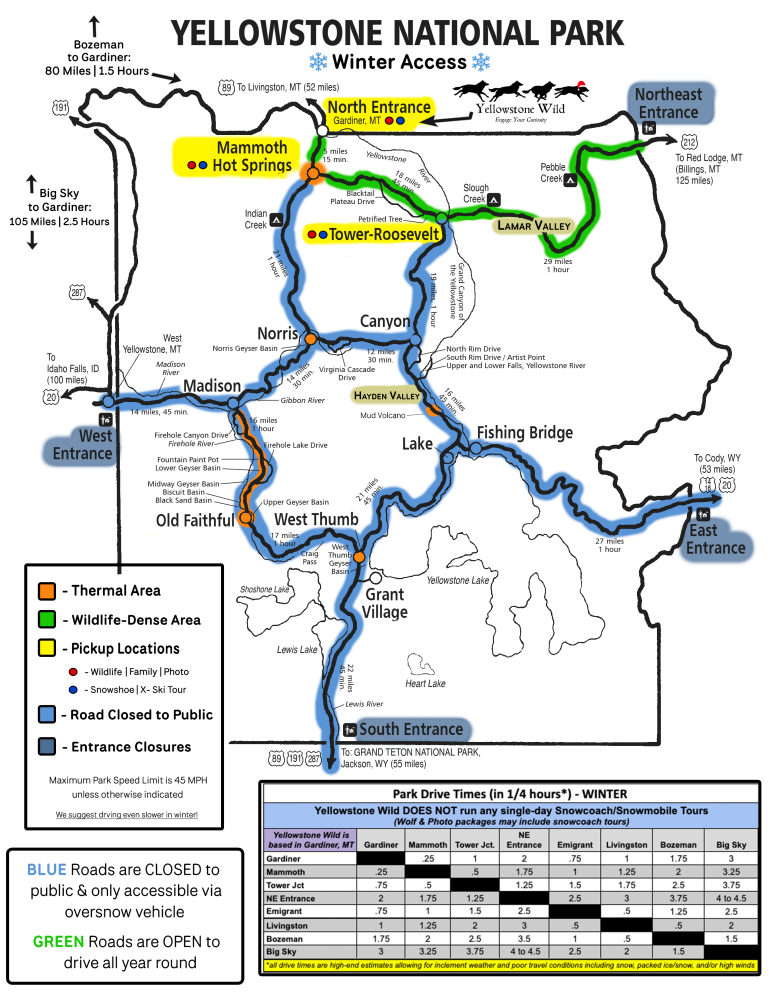
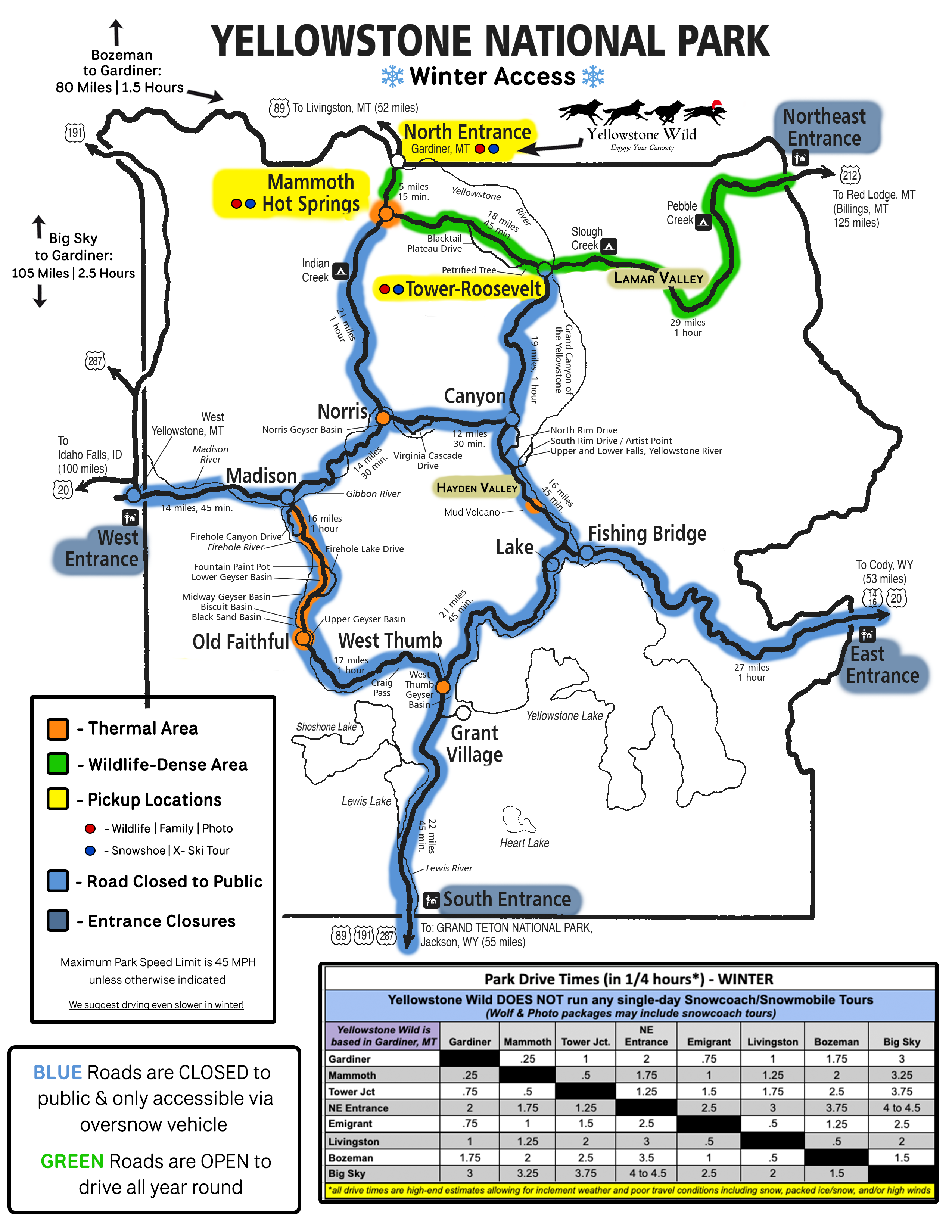
Vehicle: If you plan on driving to a designated meeting location, please review your estimated drive time HERE.
Highlights:
- Private and customizable tour – just your group!
- Experience Yellowstone’s iconic wildlife in a wild, natural environment
- Your own local wildlife guide
- Activity level based on your interests and abilities
- Breakfast and lunch – picnic style
- High quality optics for all (binoculars and spotting scopes)
- Safe, fun and educational
Your route will include exploring the Northern Range of the park via the only road open year-round to regular vehicles.
(Gardiner, MT to Tower Junction to the Northeast Entrance and back)
Learn more about winter travel and view the National Park Service winter road map HERE
Rates based on total group size
(not per person)
1 person
$ 925
2 people
$ 925
3 people
$ 1025
4 people
$ 1125
5 people
$ 1225
6 people
$ 1325
7 people
$ 1425
8 people
$ 1525
9 people
$ 1625
10 people
$ 1725
Eleven+ Guests
Call to book
*
Rates do not include 2.5% processing fee
Yellowstone National Park is world-famous for its abundance of iconic wildlife, stunning vistas and historic conservation efforts to restore wolves and bison. Our highly-experienced naturalist guides and top-of-the-line equipment produce the highest quality wildlife sightings and wilderness excursions. Deep personal knowledge of Yellowstone’s wolves, bison, moose and other treasures fuel our teachings, which appeal to all ages. We specialize in crafting personalized educational experiences with Yellowstone’s iconic wildlife, natural history and ecology around your interests and expectations. Our tours consistently prove to be meaningful and memorable to our guests.
Winter is a special time to experience wildlife in Yellowstone, as the deep snows have pushed the wildlife out of the higher country, concentrating animals on the famed Lamar Valley and Yellowstone’s Northern Range. Thousands of elk and bison fill the lower-elevation valleys and grasslands. Abundant bighorn sheep, mule deer, whitetail deer, pronghorn and moose also filter out of the mountains and concentrate where there is less snow, milder temperatures and easier foraging. This migration places them where we can best observe them and observe the predators that come here to hunt them.
Our guides track the movements and behavior of Yellowstone wildlife almost daily and know the best places to find the animals you hope to see. Your guide will interpret the behaviors you observe and share stories about the wolf packs and individual wolves that we have gotten to know over the years of observing them. You will walk through visual examples of how animals live in this beautiful landscape, what their relationships are like with the other animals and plants around them and why certain animals might live in one place over another.
-
December 1 – February 15th:
- Gardiner, MT, Sage Lodge & Chico Hot Springs:: 6:30am
- Mammoth Hot Springs: 6:45am
- Tower Junction: 7:15am
February 16th – March 9th:
- Gardiner, MT, Sage Lodge & Chico Hot Springs:: 6:00am
- Mammoth Hot Springs: 6:15am
- Tower Junction: 6:45am
March 10th-March 31st:
- Gardiner, MT, Sage Lodge & Chico Hot Springs:: 6:30am
- Mammoth Hot Springs: 6:45am
- Tower Junction: 7:15am
-
Your tour includes:
• Full-day (8 hour) private guided tour
• Local naturalist guide
• Transportation in our fully equipped touring vehicle (we drive, you enjoy the scenery)
• Plenty of space for your extra clothing – please bring warm clothing (see “What to Bring” list)
• Optics for everyone- top-of-the-line binoculars and high-powered spotting scopes for all
• Breakfast pastries and hot drinks (coffee, tea, hot cocoa)
• Healthy and hearty snacks and beverages
• Full picnic lunch spread
• Dynamic and engaging discussions interpret the wildlife activity and behavior observed
• Informed and accurate information on the biology and conservation issues surrounding the wildlife you will observeGratuity is NOT included in the price of the tour. Tipping your guide is a common practice in North America, and tips are an important part of their income.
What to bring:
Yellowstone possesses some of the most extreme weather conditions anywhere. Temperatures on any given tour could range from -40°F to +40°F (-40°C to +10°C). We therefore recommend plenty of warm clothes that can be layered and easily removed; therefore, allowing you to adjust and stay comfortable throughout your tour.
Visit our Blog “The Art of Layering: How To Dress For a Yellowstone Winter Adventure” to learn more about appropriate clothing including links to purchase or rent the items you’ll need.
Here are our suggestions and what our guides wear on winter tours:
- Long underwear. Starting with your base layers, synthetic or wool long underwear tops and bottoms are critical to your comfort (we can find places to shed this layer later in the day if necessary). Please stay away from cotton, which can hold moisture and drastically chill the body, whereas wool and synthetics wick moisture and can even insulate while wet.
- Sweater or fleece. Ideally more than one layer of insulating layers like fleece or wool sweaters will allow for effective layering and allows you to easily shed layers as the day warms up.
- Fleece or down vest. Vests are great as a layering item that can really hold in core body temperature, yet also allow for maximum comfort and mobility.
- A windproof and water repellent insulated jacket is your most important protection from the biting Wyoming winds. Gore-Tex or something similar is highly advised as the best moisture/wind barrier and goose down insulation is the best insulation.
- Snow pants/ski pants – Insulted pants with moisture/wind barrier. You should have long underwear thermal layers in addition.
- Heavy gloves or mittens with windproof barrier.
- Warm hat that covers your ears. We lose tremendous body heat from our heads. Protect your ears from the chilly wind with a wool or fleece hat.
- Warm wool or synthetic socks are key to keeping those toes from hampering your good time. Be sure you have plenty of wiggle room inside your boots. If your socks are too thick and fit too tightly in your boots, you will actually reduce blood flow to your feet, resulting in cold toes, regardless of how warm your socks are.
- Insulated winter boots (roomy boots are better as you do not want to restrict circulation in your feet/toes) (see below for boot recommendations).
- Hand and toe/foot warmers. These are lifesavers! We advise everyone to place a full-sized foot warmer inside your boots every morning before the tour. This keeps the edge off and keeps you comfortable to be able to enjoy yourself to the fullest during those hard-earned wildlife encounters! Toe and hand warmers can be used as needed
- With high elevation sun, many of us burn easily, especially when we are distracted by something like watching wolves for extended periods of time.
- Even if you are not a serious photographer, a camera is nice to have on tour.
- A day pack is very handy for personal items: hand and toe warmers, water bottle, sunglasses, camera, and of course for all the extra layers you will want.
-
BOOKING, DEPOSIT, & FINAL PAYMENT POLICIES:
In order to reserve your tour, a $200.00 deposit per tour day is due at the time of booking. Preferred payment method is via credit card through our secure booking system. The balance due will be charged to the card on file 30 days prior to your tour departure date.
CANCELLATION POLICY OPTIONS:
The Cancellation Policy that you select at the time of booking will apply to your reservation.
TRIP PROTECTED FLEXIBLE CANCELLATION POLICY +12% OF TOUR TOTAL COST
-
- If you cancel your tour 24 hours before your scheduled tour, your tour fee is fully refundable minus a $50.00/day processing fee.
- If you cancel within 24 hours your tour fee is 65%.
- We are unable to offer any refund for no-shows or tours canceled after the scheduled departure time
- The “Trip Protected Cancellation Policy” fee will be charged within 48 hours of booking and a receipt will be emailed to the email address on file
The 12% Trip Protected Fee is non-refundable. If you booked online, the “fees” charged by the third-party booking system are also non-refundable.
Rescheduling Your Tour with Us: We are happy to reschedule your tour for no additional charge up to 24 hours prior to your tour departure dependent upon availability.
EXCLUSIONS:
Guide assignment is based on availability and will not be changed based on a guide’s personal characteristics. We will honor all guest requests for a specific guide when possible but cannot guarantee you will be paired with the guide of your choice. Cancellations made based solely on guide assignment are not covered under the Trip Protected Flexible Cancellation Policy
STANDARD CANCELLATION POLICY
-
- If you cancel your tour more than 30 days in advance of your tour start date, you will receive a full refund minus a $50.00/day processing fee. If you booked online, the “fees” charged by the third-party booking system are also non-refundable.
- If you cancel your tour within 30 days of your tour start date, we are unable to offer a refund.
Should your tour need to be canceled due to factors beyond our control, including (but not limited to) extreme weather conditions, wildfire, natural disaster, park closure, airline cancellations, war, government shutdown, pandemic, or an “Act of God” we are unable to offer a cash refund.
Should your tour need to be canceled due to factors beyond our control, including (but not limited to) extreme weather conditions, wildfire, natural disaster, park closure, airline cancellations, war, government shutdown, pandemic, or an “Act of God” we are unable to offer a cash refund.
As a small business, we regret that we are rarely able to make exceptions to our Standard Cancellation Policy. ***We strongly recommend that you select the “Trip Protected Cancellation Policy” or purchase third-party travel insurance in order to protect your investment in case of unforeseen events affecting your travel plans.***
Rescheduling Your Tour with Us: We are happy to reschedule your tour for no additional charge up to 48 hours prior to your tour departure dependent upon availability.
Guide assignment is based on availability and will not be changed based on a guide’s personal characteristics. We will honor all guest requests for a specific guide when possible but cannot guarantee you will be paired with the guide of your choice. Should guests choose to cancel a tour based on guide assignment, a refund will not be provided.
Updated 7/31/26
-
-
As soon as we enter the northern gate of Yellowstone National Park, wildlife viewing opportunities abound! The Gardiner Canyon immediately greets us as we start our ascent towards Mammoth Village. This canyon is home to the McMinn herd of Rocky Mountain big horn sheep, which overwinter in this lower elevation canyon. Come spring, they spread back out and fill in their high-mountain territories throughout the Greater Yellowstone Ecosystem. During November and December, the rams can be found among the herds competing for breeding rights. The cracking sound of their impressive skulls and horns crashing together can sometimes be heard for miles. Keep your eyes up on these steep canyon walls, as nowhere is out of reach for these climbing specialists.
Climbing our way to 6,200-foot elevation, we arrive at the historic park headquarters at Mammoth Hot Springs. Originally established as Fort Yellowstone by the U.S. Army in the late 1800s, Mammoth is most known for the exquisite beauty of the Mammoth Terraces. Large herds of elk spend their winter in and around Mammoth, often providing the up-close views that have given Mammoth the nickname of Elk Town.
Here we turn to the east and find ourselves climbing ever further up and eventually over the Blacktail Plateau. Our route parallels one that has been used for tens of thousands of years, not by humans but by Yellowstone’s prehistoric survivors, the American Plains bison. Buffalo, as named by early explorers and settlers, have traveled in the footsteps of their ancestors for millennia, heading towards the lower elevations of the Gardiner basin to escape winter’s relentless assault. Along this path, we often see family groups of bison heading west and downhill, appearing as natural and adept on the landscape as the very snow itself. It is humbling and inspiring to witness these timeless creatures carry out, and pass on to the next generation, the route of this ancient migration. The open vistas and windswept landscape of the Blacktail Plateau is as good as any place along the Northern Range to experience it.
Further toward the east, we have a couple massive vistas overlooking the confluence of Hellroaring Creek and the Yellowstone River, an area known simply as Hellroaring. From our pullout views here, it is easy to become overwhelmed by the scale, with the landscape first dropping away from your feet then dramatically rising again, leaving a beautifully soft and welcoming slope below — surely, an Ansel Adams-worthy landscape, but also a winter wildlife viewer’s delight! The lower elevations along the bottom of the slope and the edges of the Yellowstone River are a welcome refuge for the large migrators of Yellowstone. Elk and bison alike gather here, sometimes resting along their march or spending their entire winter season in the bottom of Hellroaring. This concentration of prey undoubtedly draws the attention of several wolf packs that annually travel into Hellroaring for this season, also looking for a meal. Your guides use their high-powered optics to find them!
Carrying on past the Tower Ranger Station, a beacon of human life dropped into the vast frozen wilderness, we cross the Yellowstone River, and approach Little America. This area of the park is unique for its glacial erratics, evidence of a time when ice and cold truly dominated the land some 20,000 years ago. But Little America isn’t just a playground of geologic history; it’s a wolf watcher’s dream. This area, 7 miles long and 3 miles wide, is home to some of Yellowstone’s best wolf habitats. With massive views in all directions, the opportunity to spot a wild wolf is as good here as anywhere. Wolves commonly travel the road during the dark winter nights, and with the only the vehicle’s headlights illuminating the road, an experienced guide can often pick up their tracks, determine their direction of travel, and often the number of individuals to search for. This is always an exciting moment, knowing the elusive apex predator is nearby, and it’s often in Little America.
Moving further to the east, we pass through the Lamar Canyon, a cascade of the Lamar River, over boulders, ice and toppled pines, and approach the destination most intrepid winter visitors of Yellowstone covet, the Lamar Valley.
A valley often likened to “driving into a postcard” or the “Little Serengeti”, never disappoints, regardless of the season, but there is a little extra magic during a Yellowstone winter. First noticed is the Lamar, snaking it way through the valley bottom, with meanders so beautiful and natural it reminds us what rivers a supposed to look like. Dots in the distance, first appearing as rocks, turn into frosted steam generators and eventually reveal themselves. Bull bison, in bachelor groups will stay in Lamar Valley all winter, leaving the cows, and younger bison to migrate to easier pastures. Are these bulls too stubborn to migrate? Or too strong to worry about the extreme cold and snow? Regardless, they appear perfectly adapted to wait out Old Man Winter.
This sacred valley was also the site of the first wolf tracks to be laid upon Yellowstone in 69 years. The first release of wolves into Yellowstone in 1995 was right here in Lamar Valley. Since, it has been dubbed “the valley of the wolves” because of its unique opportunities to view wild wolves, living truly wild lives. It was called home by the park’s most famous, and maybe the world’s most famous wolf pack: the Druid Peak Pack, who reached its peak in 2001 with 37 members. Currently, the Junction Butte pack, and the Lamar Canyon pack both use the valley to hunt, and raise their young. When it comes to wolves in the Lamar, perhaps the most impressive wolf sightings, photographs, films and scientific research of all time have occurred right here in Lamar Valley, and everyday something new and memorable happens.
The Lamar Valley is also home to many other creatures, large and small. Golden Eagles can sometimes be seen hunting their favorite winter meal, Golden-eye Ducks along the Lamar River. Otters frequent openings along the ice-shelved river as well, always wary of trout stealing Bald Eagles. Foxes and Coyotes use the mid-day hours to hunt, when the snow is softest, and their diving plunge through it is most rewarding. We never know what may be around the next bend or coming over the ridge, but we do know, there’s always something amazing happening in the Lamar; it’s just a matter of finding it!
Moving along the northern bank of the Lamar River, past the confluence with Soda Butte Creek, we transition into the Soda Butte Valley. Here the landscape changes, from the vast expanses of the Lamar to a tighter and more dramatic section of the Northern Range. Soda Butte Creek is lined with willows, hiding the valley bottom, and therefore creating textbook habitat for another one of Yellowstone’s mega fauna: Moose. Winter is the perfect season to find these gangly, yet somehow majestic browsers. Harsh temperatures and deeps snow have pushed them to the valley floor, and often into view if you know where to look. Fortunately, we do!
We will spend the day exploring the wonders of the Northern Range: a variety and density of wildlife unmatched by anywhere else in North America, breathtaking vistas, and a natural and human history rivaling a story stranger than fiction. With the restoration of wolves and their subsequent impacts on the ecosystem, known as “trophic cascades”, Yellowstone’s Northern Range now holds all of its original species and ecological components, and scientists declare it to be every bit as wild and healthy right now as it’s ever been! The Northern Range has become a world-class destination for wildlife viewing, and immersing yourself in a truly wild ecosystem and the beauty of winter will only enhance everything you’ve come for!
-
Unfortunately, no. At this time we do not have one of the extremely limited permits required to operate an over-snow vehicle (snowcoach) in the park’s interior. We do offer an all-inclusive multi-day winter package that includes one day visiting Old Faithful in a private, chartered snowcoach. You can learn more about that package HERE:
We may be able to work with you to create a custom tour experience that includes a day in a private chartered snowcoach. Please reach out directly if you would like to discuss this option.
-
Yellowstone National Park is a reminder that everything is connected and that its landscapes thrive through balance, diversity, and coexistence – as do all of us. When the world feels divided, we turn to this wild place for lessons in how to move forward together.
At Yellowstone Wild, we promise to lead by example. We will choose curiosity over judgment, compassion over indifference, and connection over division — both on and off the clock. We welcome our guests into an environment of shared discovery guided by kindness and curiosity. On our tours, we honor the backgrounds, beliefs, and cultures each guest brings, while holding firm to the expectation of respect for one another and to this place we all care for.
We believe our tours, though limited in time, have the power to establish common ground, form connections, and share experiences that bring us closer together as humans.
Ethics, Regulations & Responsibility
Yellowstone Wild operates as a licensed Commercial Use Permit holder under the National Park Service (NPS). This means we are required to follow—and strictly enforce—all NPS rules and regulations. Beyond that, as lifelong advocates for wildlife and wild places, we uphold our own ethical wildlife-viewing, resource protection, and risk management standards.
Our goal is to provide exceptional viewing and photography opportunities without negatively impacting wildlife or the natural fluctuations of ecological processes. That balance is only possible when animals are allowed to move, feed, rest, and hunt without interference, and our geologic features are allowed to function without human tampering.
While on tour with Yellowstone Wild, the following National Park Service regulations apply and are non-negotiable (subject to federal law enforcement) including the use of seatbelts at all time when the vehicle is on a road. Please note this list is not all-inclusive. You can visit the Yellowstone National Park NPS website for a comprehensive list of all regulations:
- Maintain at least 25 yards from all wildlife
- Maintain at least 100 yards from wolves, bears, and cougars (mountain lions)
- Never approach, follow, or remain near wildlife—including birds—if your presence alters their behavior
- Vehicles must be completely pulled off the road when stopping to view wildlife or load/unload passengers
- Feeding wildlife is illegal
- In thermal areas, travel is restricted to boardwalks and designated trails only
- Throwing anything (including snow or natural objects) is prohibited and may result in fines and/or tour termination
- Seatbelts are required and enforced as outlined by the National Park Service federal regulations
Why These Rules Matter
Wild animals live demanding lives. The ethical responsibility of visiting Yellowstone is to ensure our presence does not add stress, risk, or hardship to theirs. Your guide is trained to read animal behavior, and if an animal shows signs of disturbance, we must increase our distance immediately.
Failure to follow a guide’s instructions—especially regarding wildlife proximity, adherence to seatbelt use, and group safety instructions—may result in the immediate termination of your tour without refund, at the guide’s discretion.
Special care must be taken around animals feeding on or resting near carcasses. Approaching these areas can displace animals from critical food sources and may put people at serious risk. Carcasses are often defended by predators and scavenged by multiple species, including grizzly bears. Approaching such areas is strictly prohibited.
Finally, we share this park with other visitors, researchers, and permanent employees. Quiet, respectful behavior ensures the best possible experience for everyone and helps preserve the integrity of wildlife observations and continued preservation of our sensitive thermal features, waterways, and all pristine areas.
At Yellowstone Wild, ethical behavior is an expectation. Meeting these expectations is the foundation of meaningful, safe, and responsible wildlife and wilderness experiences.
-
If you are visiting Yellowstone to celebrate an important milestone in your life (anniversary, birthday, honeymoon or graduation) or are simply on a much-needed family trip, our Adventure Portrait Photography Package is designed to capture your special moment. Our partner, Jess, at Chocolate Moose Images specializes in classic portraits as well as highly candid photographs in and around Yellowstone National Park. Jess has a special gift for capturing genuine moments that vividly portray personality and emotion – and in a setting like Yellowstone, personality and emotion shine bright!
Jess will visit with you before your tour to develop a rapport, share ideas with one another and discuss how her photo shoot works. She will then join us on your tour out in the wilds of Yellowstone. She works discretely to capture meaningful moments of you exploring Yellowstone, while also keeping her trained eye open for the perfect Yellowstone-themed backdrop for your portraits. If you have more specific questions about how to customize this for your adventure, please reach out to Jess.
Cost: $789 including a planning session on the phone as well as 3-4 hours on tour, candidly capturing your experience. Additional ‘formal’ and more posed session available as an add-on, scheduled for a different time than the tour.
Final products: Around 30 low resolution images delivered in an online gallery. Printing services are available and highly encouraged. High resolution files also available.
Still have questions? Check out our FAQ’s page!